Chinese Brush Calligraphy: A Practical Introduction
Chinese calligraphy, known as Shufa, has been practiced continuously for over three thousand years. It remains one of the most respected art forms across East Asia, valued not only for its visual beauty but for the discipline, patience, and philosophical depth it cultivates in its practitioners. In Singapore, where Chinese cultural traditions are deeply rooted, brush calligraphy continues to be practiced in community centres, cultural associations, and private studios across the island.
The Four Treasures of the Study
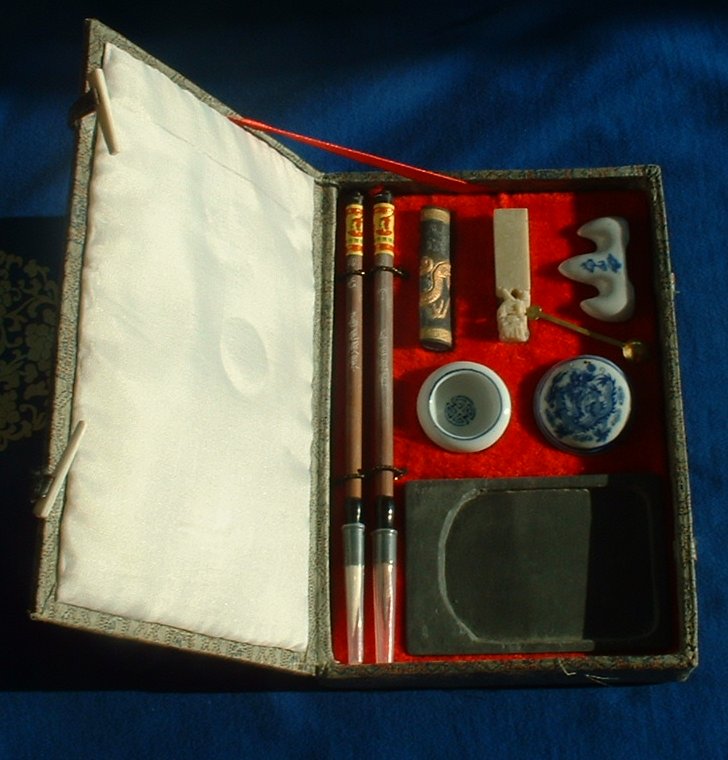
Traditional Chinese calligraphy relies on four essential tools, collectively known as the Four Treasures of the Study (Wenfang Sibao). Each element has been refined over centuries and directly influences the quality of the finished work.
The Brush
The calligraphy brush consists of animal hair bound to a handle, typically bamboo. The hair type determines the brush's behaviour: goat hair produces soft, absorbent strokes ideal for flowing cursive scripts, while weasel hair (marketed as wolf hair) offers a firmer, springier response suited to precise Regular Script characters. Mixed-hair brushes combine both characteristics and are widely recommended for beginners.
A well-made brush exhibits four qualities known as the Four Virtues: sharpness at the tip (Jian), roundness in the body (Yuan), evenness of the hairs (Qi), and resilience when bent (Jian). Testing a brush before purchase by wetting the tip and checking its point is standard practice at Chinese stationery shops.
The Ink
Ink has traditionally been prepared by grinding an ink stick against an ink stone with a small amount of water. Pine soot ink produces a cool, blue-black tone, while oil soot ink yields a warmer, glossy black. The grinding process typically takes five to ten minutes and is considered a meditative warm-up that focuses the mind before writing begins.
Bottled ink from brands such as Yidege and Zhonghua is a practical alternative used by most everyday practitioners. When using bottled ink, adding a few drops of water can adjust the consistency for different paper types.

The Ink Stone
The ink stone provides a smooth, slightly textured surface for grinding ink sticks. Duan stone from Guangdong province and She stone from Anhui province are the most prized varieties, valued for their fine grain and ability to produce smooth ink. For practical purposes, any flat ceramic or stone surface with a slight texture can serve the function.
The Paper
Xuan paper, made from the bark of the blue sandalwood tree mixed with rice straw, has been the standard surface for Chinese calligraphy since the Tang Dynasty. Its high absorbency means ink spreads quickly into the fibres, which rewards confident, unhesitating strokes. Raw (sheng) Xuan paper absorbs more readily and is used for expressive styles, while processed (shu) Xuan paper is treated with alum to reduce absorbency, making it more forgiving for beginners.
Fundamental Brush Strokes
All Chinese characters are constructed from a set of basic strokes. The character Yong (meaning "eternity") is traditionally used as a practice template because it contains the eight fundamental stroke types:
- Heng (horizontal) — drawn left to right with a slight upward arc
- Shu (vertical) — drawn top to bottom with steady pressure
- Pie (left-falling) — a diagonal stroke moving from upper right to lower left with decreasing pressure
- Na (right-falling) — a diagonal stroke moving from upper left to lower right with increasing then decreasing pressure
- Dian (dot) — a short, pointed stroke placed with a quick press and lift
- Ti (rising) — a short upward stroke from lower left to upper right
- Zhe (turning) — a horizontal stroke that turns downward at a sharp angle
- Gou (hook) — a vertical stroke ending with a short upward or sideways hook
Mastering these eight strokes through repetitive daily practice establishes the foundation for writing any of the approximately 50,000 characters in the Chinese writing system.
Major Script Styles
Seal Script (Zhuanshu)
The oldest standardised script, dating to the Qin Dynasty unification of writing. Characters are symmetrical, rounded, and highly structured. Seal Script is primarily used today for name seals (chops) and formal inscriptions.
Clerical Script (Lishu)
Developed during the Han Dynasty as a faster alternative to Seal Script. Characters are wider than they are tall, with distinctive horizontal strokes that flare outward at the ends (known as "silkworm head, wild goose tail"). Lishu remains popular for signage and decorative purposes.
Regular Script (Kaishu)
The most standardised and widely-taught script, established during the Tang Dynasty. Each stroke is clearly defined with proper start and end points. Regular Script is the foundation of modern printed Chinese characters and the recommended starting point for beginners.
Running Script (Xingshu)
A semi-cursive style that connects certain strokes for faster writing while remaining largely legible. Running Script is the most commonly used style for everyday handwriting and personal correspondence among practiced calligraphers.
Cursive Script (Caoshu)
The most abstract and expressive style, where strokes within and between characters are connected freely. Individual characters may be significantly simplified or merged. Cursive Script prioritises rhythm and expression over legibility and requires extensive experience to both write and read.
Brush Holding and Posture
The standard brush grip positions the brush vertically, held between the thumb, index finger, and middle finger, with the ring finger providing support from behind. The palm remains hollow enough to hold an egg. The wrist stays elevated above the paper surface, with movement originating from the shoulder and elbow for larger characters.
For small characters, the wrist may rest on the table for stability. For large characters or hanging scrolls, calligraphers typically stand, holding the brush at chest height with the full arm directing movement.
Practicing in Singapore
Singapore has a strong Chinese calligraphy community supported by several established organisations:
- The Singapore Calligraphy Centre at Telok Ayer Street holds regular practice sessions and exhibitions featuring both traditional and contemporary brush work.
- Community centres across the island, particularly in Toa Payoh, Bishan, and Bedok, offer subsidised calligraphy classes for residents of all ages. Many are conducted in Mandarin, though English-language sessions are increasingly available.
- Chong Zheng Calligraphy at 1 Pemimpin Drive provides structured courses with graded progression from basic strokes to advanced script styles.
- The Chinese Heritage Centre at Nanyang Technological University maintains an archive of historical calligraphy works and periodically hosts public exhibitions.
Annual events such as Chinese New Year calligraphy fairs at Chinatown and temple calligraphy demonstrations during the Mooncake Festival provide opportunities to observe skilled practitioners at work.
Wang Xizhi, the fourth-century calligrapher often described as the Sage of Calligraphy, is said to have practiced so intensively that the pond where he washed his brushes turned permanently black. His Preface to the Orchid Pavilion (Lantingji Xu) remains the most celebrated work of Chinese calligraphy and is still copied by students worldwide as an exercise in mastering Running Script.
External References
Chinese Calligraphy (Wikipedia) — comprehensive background on the history and styles of Chinese brush calligraphy.
Chinese Calligraphy (The Metropolitan Museum of Art) — historical timeline and representative works.